Pages

Showing posts with label environment. Show all posts

Monday, April 18, 2016

Protect Pacific Whales..


A very exciting time for our beloved whales as the focus for 2016 and 2017 SPREP programme, more information on the websites below:


The Pacific Island region is home to over half the world's species of cetaceans, whales and dolphins, including some of the least known, and as such members of the Secretariat of the Pacific Environment Programme (SPREP) agreed to focus their activities in 2016 and 2017 on a targeted regional campaign on whales. 

The ‘Protect Pacific Whales – Ocean Voyagers’ Campaign provides an opportunity for SPREP and all its Members and partners to celebrate these magnificent creatures, raise awareness on whales and their conservation, but also on ocean conservation. What happens in the ocean will inevitably impact whales.  The campaign will also address the problems facing them as ocean-dwellers that will surely ultimately impact us all.

The programme of work that is envisaged for the Protect Pacific Whales Campaign is an ambitious mixture of scientific research, training and capacity-building, exchange of information, and cultural and artistic celebration.

Join us to celebrate  whales and their place in Pacific cultures, promote their protection in the face of emerging threats, support measures to enhance their conservation, and to maximise the economic return available to Pacific island communities from the development and application of best-practice guidelines for whale-watching.  
For more information, visit our website (English and French versions available) https://www.sprep.org/yearofthewhale  and contact us at pacificwhales@sprep.org.

Wednesday, October 21, 2015

Introducing Meredith...


Meredith on the right with Lisa.


My name is Meredith Tufunga.
I’m 19 years old.
My parent is Suvenia and ‘Amusia Tufunga.
My favourite subject is Biology and Computer. 
My favourite colour is green.
I come from Olo’ua Island and I stay at Kameli.
I have ten members in my family. There are three boys and seven girls.
I was study at Mailefihi Siu’ilikutapu College for 5 years at end up at Vava’u High School for 3 years.
I’m very glad to take this time so I can share how happy I are when I became VEPA members. When I get the job I’m very happy because it can help me by increase my knowledge not only that but I know that I can fulfil my dream. Most of the time I always dream that one day I can do something so I can help to make our environment clean and not only the clean and green but also to stop the pollution that occur in our environment. So now I join VEPA so i can work together with the VEPA to protect our environment because I know that today problem in our environment can produce a huge concern for us in the future. 

So I think it’s time for us TONGA to stand up and work together for a BETTER ENVIRONMENT in the future. So the REEF OF TODAY IS THE ISLAND FOR TOMORROW. 

Meredith joins in the awareness program with Lisa, Moala and Ofa.

Thursday, January 29, 2015

VEPA Environmental Awareness Program - Jan 2015


So welcome back from Hainite, Lisa and Moala:
The Community Awareness Team -
Lisa, Hainite, and Moala


The Community Awareness Team now all in green!

We’ve had a great break and are back in our ta‘ovala’s

Ready to take-on twenty fifteen!


Presenting to all the GPS teacher's at Vava'u High

To kick off the new year with excitement

We went to the government high school

And told the teachers about the environment,

Which they said they thought was pretty cool.


Our team are now getting gee-d up

To teach everyone about our mangroves,

We’ve written a kids book, the schools are tee-d up,

And the replanting has begun, way to go!


Red Mangrove seedling

 
Something else we have to look forward to:

A Whale Competition for you to tell your tales

About what they mean to Tonga, to me, and to you,

And the prize? Winners will spend a day with the whales!


New office opening - Karen and Kate
Next step is to spruce up the new office

With interesting posters and pictures to peek at

If you haven’t found us we’re near the Dancing Roosters,

Come on by when you can and meet us!

Tuesday, April 9, 2013

Vava'u Coral Reefs


Coral is an important piece of the environment that we need to protect.  I come from Australia and people have told me about the swimming in the Great Barrier Reef.  The majority of these people say it is not as good as it has been in the past.  This is because of humans as we use boats that anchor on the reef and also rubbish that gets blown into the ocean.  Coral grows very slowly and we have come along and bit by bit destroyed coral that is thousands of years old.  We are only starting to protect the Great Barrier Reef now.
Just some of the colourful marine life in Vava'u

Vava’u has hope as there is beautiful coral around in Vava’u and we need to protect that by being careful where we anchor yachts, ships fishing boats etc.  We also need to clean up the rubbish that’s on the road and put it in the bin, otherwise people are going to be called lazy and then I vote to change earths name to ‘The Laziest Planet in the Solar System’.

Coral bleaching on a reef in Vava'u


I learnt another thing while snorkelling with a VEPA volunteer in the Neiafu bay outside my place.  This is a bad process called erosion, where silt or mud is washed into the ocean when it rains and covers the coral.  Living in the coral is a little plant called Zooxanthellae, which helps keep the coral alive.  The coral provides a protective home for the plant and the zooxanthellae provides food for the coral through the process of photosynthesis (breathing in carbon dioxide and releasing oxygen).  It’s just like trees only the fish use the oxygen instead of land animals.  The silt covers the coral so the Zooxanthellae can’t breath and die and then the coral dies.  When coral is dead it looses all it’s colour and turns white.
Vava'u's clear waters are fantastic for divers visibility. 

So please get off the couch and help VEPA and other organisations with our environment.  Not just coral but tree’s, animals (reptiles, fish, whales, land animals etc).  So please help any environmental organisation you can so we don’t have to change earths name to ‘The Laziest Planet in the Solar System’.  

By Ashlee Jones (student at Saineha High School)

Monday, February 25, 2013

Water Quality Education and Awareness


In late 2012 VEPA was donated a water quality educational pack from Melbourne Water Corporation and Baulderstone Pty Ltd.  The pack is designed to teach students about different water quality parameters, including dissolved oxygen, turbidity, pH, temperature, nitrates and phosphates.

Since receiving the equipment we have had fun teaching students about water quality, including how to monitor various parameters and what impacts human activities can have on water quality.   The equipment has also been used to assist the ministry of Environment and Climate change to measure water quality at the rehabilitated rubbish dump.


USP Student (Josh) measuring dissolved oxygen


For the first Nature Explorers Club students from the University of South Pacific measured the temperature, pH, Dissolved Oxygen and Electro Conductivity in the Port of Refuge.   I also did a presentation to the Form 5 biology students at Mailefihi Siuiliku College and afterwards we measured the DO concentration from a water with algae.  Not a scientifically sound measurement, but it taught the students about DO and what role it plays in keeping a healthy ecosystem.   It was also a good example of how algae can reduce the DO concentration. 

Presentation to Form 6 Biology students at MSC
In my previous job I used to do water quality monitoring by just sticking a couple of probes in the water.  Technology has made water quality monitoring very accurate and extremely simple.   Unlike the advanced equipment I am used to the equipment donated uses a modified Winkler method, chemical reactions to calculate the dissolved oxygen concentration.  This is not as accurate as a probe but much more exciting!  The students were mesmerized when the water turned purple (manganese oxide hydroxide oxidizing the iodide to iodine) and then clear again by adding the titration (thiosulfate) to reduce the iodine back to iodide ions. 

Thank you to the Water Resource Alliance for donating the equipment. 
We are hoping to do more presentations in the other high schools over the next two weeks and continue to do the dissolved oxygen exercise to teach the students about the important relationship between oxygen levels and maintaining a healthy aquatic ecosystem.     

Elana Balderstone
VEPA Volunteer (Aus Aid)

Wednesday, January 23, 2013

Exploring Vava'u's Environment

Vava'u Island group comprises of over 40 limestone islands of which only 14 are inhabited. The natural resources of Vava'u are scattered between the marine and terrestrial environments.

Each month we will be writing a blog post on different areas of Vava'u environment to help share in its beauty, we will also be discussing other topics of conservation interest that threaten and potentially effect the environment and the communities who use them.

We would love for people to share with us topics that they would like to hear about so please add comments and share around.

Our first topic which will be for the end of the month is the terrestrial or land environment.

Some of the stunning islands.

Monday, January 7, 2013

Vicky's Experience as a VEPA Volunteer


Loved it. It was an amazing experience I will never forget. Where to start? ... VEPA, it is an honour to have been part (even a tiny little part) of this organization, its strong, honest, devoted dedication to the community, giving back to the community asking nothing in return other than cooperation... every time I’ve had to mention I was a VEPA volunteer, I said it with pride. It is really good that almost every person I’ve mentioned VEPA to, knew what it was. It’s great to see that the organization is growing, and more and more people want to get involved (whether its a little bit or a lot).


And this wouldn’t be possible without the amazing work of Karen Stone and Elana Balderstone. Of course the rest of the board members, volunteers, and friends of VEPA are all part of the success of VEPA, but I will speak of Karen and Elana because I worked with them the closest. Two amazingly hardworking women that breathe and sweat VEPA.
I keep saying to everyone I’m the luckiest person in the world for having been assigned the Matamaka Coral Nursery Project. It involved everything I enjoy... field work, kids, culture, beautiful scenery... I’m not very good with paperwork and computers, and even though I mentioned I would have like to help more around the office, I am very glad I was out doing hands-on work most of the time, and in a stunning place like Matamaka, who would complain?! I love swimming, I love the ocean... having it as my ‘office’, I enjoyed the early wake-ups. The most rewarding part was probably being involved with kids. They are so much fun, always excited to go swimming and for me to show them the reef. My first week there, I was teaching them how to use the snorkels and fins. They picked it up pretty fast. Sometimes there were a few problems with water getting in the mask. After that it was always “Vicky, are you going Swimming? Can I come with you?” and that way, every week I’d take a few kids out. 
I think they didn’t even know they had that reef there or what a reef looked like until they saw it through the masks. The moment we started approaching the first corals (and seeing the first fish), they would not stop pointing at anything and everything!  I would tell them the family names of the fishes but it was all too confusing in the water with so many fish around us. We did a little activity in class where they had to colour some black and white fish and match them to some photos of the common fish I had seen in Matamaka. They loved that and they were all very artistic. Having spent almost as much time in Matamaka as in Neiafu, I truly got to experience the Tongan culture. At first, the adults in the village were a bit confused about who I was and what I was doing there but little by little I got to know a few of them, and they got to know me, and then it became a normal thing having me walking around the village. I travelled on the little fishing boats every time to and from Matamaka, ate Tongan food (and Tongan portions), ‘showered’ with a bucket of water, went to church a few times, served kava, went camping, danced, sang, and laughed a lot.
Building the coral nurseries was fun, I’d walk around the village looking for the materials, take them to my little office (the tree by the jetty), putting the ropes and the frames together, placing them in the water...   starting to get the feeling that everything was finally coming together. Then, finding the right coral fragments and attaching them to the frame, that’s when it started getting a bit more complicated and cold (spending maybe 2 hours in the water until I could no longer feel my fingers). Collecting the corals was not as easy as I thought at first. 
Yes, there were a lot of fragments on the seabed, but as the beach in Matamaka does not get any wave action, fragments found there have been broken off by past cyclones. Who knows how long these fragments have been lying there, most of them have some algae growing on them. I’d dive to collect a fragment, which looked good from the surface and then turned out that the bottom was covered in algae. I ended having to replace many fragments week after week.
Another little complication was finding the perfect location to place the coral frame. Corals need clean water, with low nutrients and no suspended sediments. The first location chosen was not good, so much sediment everywhere...after a week when I went to check on them, all the fragments were bleached and covered by the sediments. I then decided to move it to the other side of the jetty where there is plenty of coral and a lot more fish. This turned out to be a much better location as most of the fragments kept their colour when I checked up on them week after week. Since we had a spare frame thanks to IMAX donating the materials, the second one was placed on the right side of the jetty but away from the rocks and all the sediments. It is a bit deeper but it’s on a sandy area and was placed next to a bommie with at least 5 different species of corals growing on it. We’ll have to see if the depth at which the frames were placed has any effect. Hopefully the coral will grow well on both frames! I’d love to come back next year (or in a few years) and see the small fragments turned into big colonies!
Hopefully the kids will stay motivated and continue the monitoring to the point where they see some growth and understand the benefits of the reef. Nevertheless, I do believe the kids learnt something, even just a little bit about how important the reef is and that it is crucial to look after it.
My experience as a volunteer for VEPA was truly amazing. I am really looking forward to coming back to Vava’u and of course being involved with VEPA again! Thanks so much to everyone in VEPA for giving me this wonderful experience.

Ofa 'atu, Vicky von Bernard, International Volunteer 

Tuesday, December 18, 2012

Santa Came Early for VEPA this year


It’s been awhile since I’ve written a blog for VEPA.  We have been so active over the last couple of months with the lovely international volunteer Vicky managing the coral reef nursery out at Matamaka (sad to see her go), the Nature Explorers Club, Karen and Kate rescuing turtles and running workshops for the board.  

The new year will be a busy time for VEPA as in the last month we have successfully been awarded not one but TWO grant applications, and an unofficial acceptance on another.  In addition to this The Vava’u Turtle Monitoring Program has been awarded the Prince Bernhard Nature Fund, which will supply funding to purchase a vehicle, rent for an office space and office equipment. 

The excitement started when we found out VEPA was successful in getting funding for a joint composing project with the Women’s Division in the Ministry of Agriculture Fisheries Forestry and Farming (MAFF).  The New Zealand High Commission has kindly funded this project and we will start building the compost at the MAFFF farm in January 2013.   Following the construction of the compost a series of composting workshops will be held for the women’s groups of Vava’u.  We will show them a variety of easy low cost compost types, which will not only improve soil quality but also reduce the amount of green waste being burnt. 

In the village of Toula the Australian High Commission will be funding a waste management and recycling project.  Two recycling stations will be set up where residents can separate their plastic, aluminium cans, steel cans and glass.  These cages will be collected once they are full and taken to GIO Recycling.  VEPA will be assisting Toula to plan, implement and monitor the project.

Lastly, but arguably the most exciting, it looks like VEPA will get funding to employ a part time project manager and run a year long project on sustainable mangrove management.   We will keep you updated when the official agreement has been signed.  

The new year will also bring a new office space.  We are currently looking at a cosy little space, ideally located in the centre of town with a ‘terrible’ view of the beautiful Neiafu Harbour.   This space will be shared with Kate, who manages the Vava’u Turtle Monitoring Program.

I hope all the VEPA followers have a wonderful Christmas and I look forward to updating you on VEPA’s activities in 2013.

Ofa atu
Elana

Tuesday, October 30, 2012

Turtle Release 26th October


Upon arriving at work this morning we were alerted to a turtle that was on a local fishing boat, the fishermen allowed us to purchase the turtle for TOP30. Though we do not like paying for turtles as a means to preserve them unfortunately this is often the only way we can secure a release.

Kate Walker with the Turtle 
Monitoring Project
The small green turtle was in a very healthy condition luckily and only had 3 minimal scratches possibly from being in the boat. We brought it back down to the waterfront and Kate came over to take measurements and to tag the turtle with flipper tags.

 47.5 cm in length of the carapace
The green measured 47.5cm in length of the carapace or shell and although the minimum catch size is 45 cm we are currently in the closed season for hunting. The Vava’u Turtle Monitoring Project aims to reduce the illegal catches of turtles such as this one through community assistance and education. This program is running alongside of VEPA and VEPA will continue its work to raise awareness and rescue turtles as we can.

Once the turtle had received its 2 flipper tags, it was whisked off back to the ocean and released near some sea grass beds, which is the main food source for green turtles.

Tagging the turtle's flipper
At 47.5cm this turtle is not yet sexually mature and sexual identification is hard to determine, turtles will disappear from the nest to the open ocean and float around until they come back to shore at approx. 20cm (dinner plate size though I hate using that term as a marker!). The estimates of sexual maturity range between 20-30 years old and this turtle had quite a way to go before reaching that stage.

The tagging of this turtle enables us to monitor if it is caught or seen again, and the information is passed along to the pacific database.

Karen Stone and Langi at Dive Vava'u
The turtles are about to begin their nesting season here and between the VTMP and VEPA we hope to successfully engage communities to recording and establishing data with us. This will work towards the goal of reducing catches and egg taking and turning towards turtles as an income source for communities through eco-tourism.

VEPA would like to thank all those involved in the successful rescue this morning, we are hoping for more successes as the Turtle project comes into full work soon.

For more information on VEPA and the turtle project please contact us by email on info@vavauenvironment.org or turtles@vavauenvironment.org.

Facebook us on: VEPA http://facebook.com/vavauenviro or http://facebook.com/vavauturtle

Blog post by Karen Stone (VEPA Project Coordinator) 

Thursday, October 18, 2012

October Terrestrial Environment Presentation


In the month of October VEPA headed out to the local high schools to do a presentation on the terrestrial environments and some human influenced impacts Vava’u is facing.

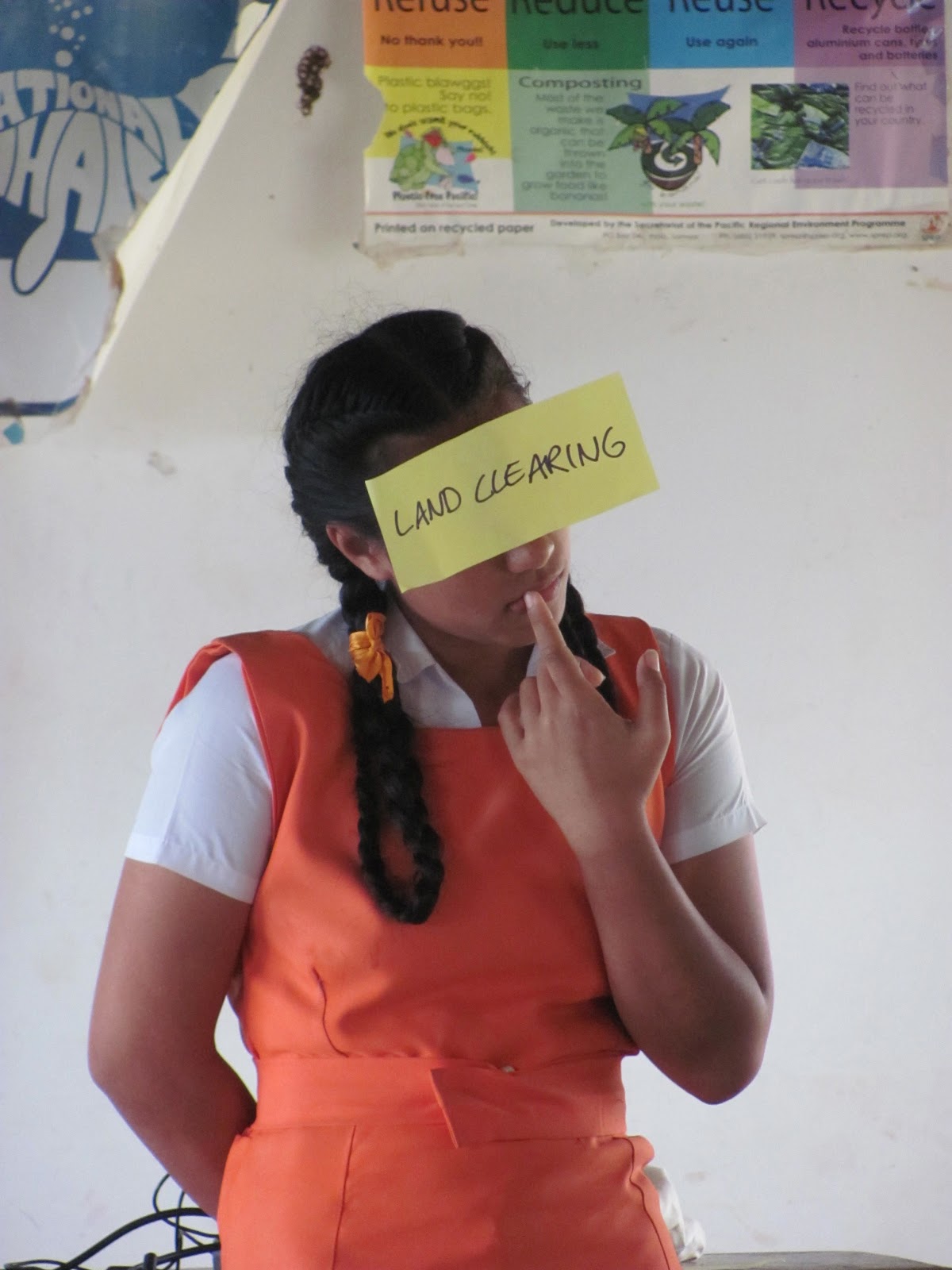
Student playing 
environmental celebrity 
heads
Vicky von Bernard (VEPA international volunteer) and I completed three presentations at Mailefihi Siuiliku Tabu College, Tailulu and Saineha Secondary School.  Unfortunately we were not able to complete the presentations at the other schools due to exams. 

The presentation touched on terrestrial biomes around the world, the unique Tongan biodiversity and endemic species as well as soil erosion, deforestation, dryland salinity, pollution and recycling.  

Elana and Viki a student 
from Tailulu

From previous presentations we have learnt that the students are shy and unwilling to put their hand up to ask questions or answer questions I ask them, even if they know the answer. To try and ‘loosen’ the crowd up we played Environmental Celebrity Heads with them.  A volunteer was chosen from the crowd to come up the front.  An environmental process or topic was stuck on their heads and the rest of the class had to help them guess what it was without telling them the directly.  For every right clue they got a lollipop.  Its amazing how kids shyness melts away when offered a sweet!

The students at Tailulu School in particular touched me.  With two enthusiastic students coming up to me at the end of the presentation and explaining their passion for the environment and how they would love to come and volunteer for VEPA!  Sesika and Viki thank you for your dedication towards protecting Vava’u’s environment.  I look forward to working with you on future  VEPA projects. 


‘Ofa atu
Elana