Pages

Showing posts with label biodiversity. Show all posts

Friday, January 13, 2017

Outer Island Surveys - Turtles, Birds and Trash!

December through March, outer island surveys are conducted by VEPA staff for the Vava’u Turtle Monitoring Programme, and today was the first day that the weather and swells have been kind enough for us to initiate our annual monitoring. Well the weather was polite but definately not kind as it decided to pour with rain all morning, making visibility quite difficult for navigation. However, thanks to our Captain, Riki Tiki Tours, safety is always considered first. By the time we had finished our surveys the skies were clearing!


The turtles for Tonga, nest between the months of December through March, often the females have migrated from Samoa or Fiji to return to the nesting beaches here to lay their eggs, these nesting beaches are the same for the female turtle as where they were born, so the health of these islands is of major importance to the survival of turtles. This includes the management of invasive species such as rats as well as reducing the amount of rubbish and waste that is left or drifts upon these fragile habitats.


A turtle nest (pit)

Six turtle nests were identified and tagged during the surveys today, sadly many of the tracks had been washed away with the extreme high tides and swells we have had recently.


There has been a lot of sand shift on our outer islands which results in large areas of exposed sandstone, making it harder for the turtles to access the sand areas for nesting as shown in the picture above!

Not only are the outer islands important for sea turtle nesting, but also for sea bird nesting and today we were treated to a variety of chicks. A new one for us today was the very young chicks of the Black Naped Tern (Sterna sp.), a ground laying bird that builds small rock nests upon the beach or lay their eggs in the shrubs just above the high tide mark. As they are ground nesters, these chicks and eggs are extremely susceptible to predators and damage from picnic parties that do not know they are there.

A Black Naped Tern chick being protected by the coral rubble and rock nest.


The eggs of a Black Naped Tern laying along the shoreline above the high tide mark.


 Other chicks spotted were the resident noddy, however only a few chicks were spotted in comparison to other years. Whenever, you conduct outer island surveys on bird nesting islands, you have to be not only careful where you put your feet, but also not to disturb the chicks that are on the low shrubland along the coast.


A noddy chick sits just off the ground in the low shrubs on the outer islands.


Sadly though, the islands were also blighted with plastic waste, diapers, glass bottles and some PVC tubes that we believe may have been used as a float.


Two of these PVC tubes were collected on seperate beaches


Thanks to the hard work of our team today - Lisa, Seini and Kelli, the islands were left much cleaner than when we got there.


The photos above show the team of Lisa, Seini and Kelli cleaning up the two outer islands surveyed today, its always so sad to see the waste discarded on the beaches and impacting upon the marine and terrestrial life that inhabits these islands and the surrounding area.


Tuesday, June 7, 2016

Meet our new volunteer

Malo e lelei! 

I'm VEPA's new volunteer from Canada. I am studying for a Bachelor of Philosophy and Interdisciplinary Leadership at Renaissance College, a part of the University of New Brunswick. A truly wonderful and unique program that has helped me to be able to volunteer here in Vava'u. Aside from this, I am studying environmental science and plan on focusing my future studies on marine conservation, so I am extremely excited to have this opportunity to volunteer with VEPA and their amazing island preservation initiatives!

Growing up, I have always been involved with environmental programs in my community and school. The summer prior to this I had the opportunity to intern with the Nature Trust of New Brunswick, a non-profit land trust organization that focuses on education, stewardship, and conservation of significant land in New Brunswick. A truly amazing organization that inspired me to focus my studies on conservation, specifically marine conservation from working on the coastal preserves, which fit perfectly with the work that VEPA is currently undertaking. 

Left to right: Lisa, Meredith, Courtney and Seini


So far, my time in Tonga has brought me nothing but pleasure. I've experienced a feast, church, VEPA events, and have met so many incredible people. The kindness and hospitality that has been shown towards me so far has Tonga living up to its reputation of being the "Friendly Islands"! I'm looking forward to getting to know more about Tonga's people, culture, and ways of life in the next 11 weeks that I have with VEPA. 

Malo,


Courtney

Monday, May 30, 2016

Blog 2: Marine Habitats

Part of our community awareness program for the “Our Ocean” project, funded by the Waitt Foundation, is to further the information to communities on the different marine habitats that are located in Vava’u. This awareness need was also highlighted for critical importance through the "Rapid Assessment of Biodiversity of the Vava'u Archipelago" (SPREP, 2014)

The following is an overview of each habitat, our next blog post will cover the importance of “ecosystem connectivity” and why we have to think big when looking at marine resource management and protected areas!


Mangroves are shrubs or small trees that grow on mudflat areas close to the shore. Mangrove shrubs are a salt tolerant that are able to live in harsh coastal conditions.

Mangroves habitats provide shelter for juvenile marine species to be safe from large predators through using it’s aerial root system and provide suitable habitat for oysters and other mollusks.


Mangrove areas also help reduce land based pollutants from entering the coastal waters by absorbing quantities of nitrates and phosphates through their roots as well as absorbing trace metals into the sediments.
They are also important for coastal communities as they protect our shores from large storms and waves by reducing their potential energy.  

Seagrass are a type of plant that have roots below the sandy bottom, they are commonly found in shallow, clear coastal waters. Seagrass provide shelter for a wide variety of marine species within the ocean and are a favoured food by Green sea turtles. It also helps protect and stabilise the ocean floor sediments from being eroded by wave actions and is a large carbon storage area.  


Intertidal zones, are mudflat areas exposed at low tide, this is  where communities usually do their gleaning activities for invertebrates such as the sea cucumbers, clams and other species. Clams and other seashell organisms help the ocean by cleaning the water through filter feeding.


Coral reefs are formed by tiny sea creatures named polyps that are identical to the families of jellyfish. Polyps release calcium carbonate to it’s base that form up layer by layer for so many years before it creates the hard coral reef system. 
Coral reefs are very significant as they provide shelter and food for various marine organisms and are home to some of the greatest biodiversity in the planet. 
They also safeguard our shores from large wave actions and storm. Coral reefs attract tourists from around the world and are also a very important habitat contributing to beach formation. 


Pelagic seas, are found off the coral reefs and coastal areas where waters may reach thousand of meters in depth. The pelagic seas are home to a multitude of species at varying stages in the lifecycle, as well as being critical for migratory species such as marine mammals, predatory species such as tunas and sharks.


All marine habitats are of great importance to ecological, social and economic benefits, they suffer grave threats from habitat destruction, over fishing and harvesting,  as well as land based activities such as the use of fertilisers and climate change impacts.

Friday, March 7, 2014

Coral Bleaching event in the Vava'u Group.....


A rapid survey team assessing the reefs on Tonga reports observations of the first stages of mass coral bleaching.  The SPREP (South Pacific Regional Environmental Programme) BioRAP (Biodiversity Rapid Assessment Programme) working in the northern Tonga group of islands called “Vava’u” reports about 1-3% of corals are bleached.  Some corals are white; others partly white, and others are neon colors like light blue or yellow. 
Due to increasing water temperatures, the NOAA Coral Watch program previously announced a bleaching watch for Tonga (February 2014).  The team, recorded seawater temperatures rising in the last week to about 30.5o C, as well as the appearance of bleached corals.  Most of the bleaching observed was between 10 meters and the surface, however individually bleached coral colonies were observed up to depths of 30 meters in some places. A range of coral species was recorded as bleaching.
Corals bleach when increased seawater temperatures occur over a period of time; the corals, which are made up of skeletons, animals and single-cell plants, are placed under stress. When the algae (zooxanthellae or plant living within the animal), which give corals not only its color but also the ability to photosynthesize and feed, are released by the coral colony, the coral becomes bright white. As the coral has lost the plant component it loses them as a food source and is under extreme stress to survive.  Corals may recover from bleaching events if seawater temperatures decrease to within the limits of coral development. Bleaching events effect many different areas of the marine ecosystem including the reef fish as well as weakened coral reefs provide little protection for shorelines.
Area of bleaching coral within the Vava'u archipelago.

Most days have been sunny, with very light winds and small waves, but February 28th was cloudy and rainy when the team departed Vava’u.  The SPREP BioRAP team was surveying reefs and terrestrial ecosystems in the Vava’u group in support of conservation planning in Tonga.  The Kingdom of Tonga is located north and slightly east of New Zealand, and east of Fiji in the Pacific, and the Vava’u group of islands is at about 18.6500o S.
The coral reef areas identified as bleaching sites will continue to be monitored and recorded for further analysis.
The marine team was based on the Waitt Institute Scientific Platform to conduct the marine surveys of Vava’u as part of the BioRAP programme with SPREP, Ministry of Lands, Environment, Climate Change,  and Natural Resources, Waitt Foundation and VEPA.

Wednesday, February 19, 2014

BIORAP Survey of the Vava'u archipelago

This is a vital and important survey initiated by Ministry of Lands, Environment, Climate Change and Natural Resources, SPREP, Waitt Foundation and VEPA, to explore the habitats of both land and sea for species diversity, species habitat and to collaborate resources for the improved ecosystem health of coral reefs, sea birds, reptiles, marine mammals and not forgetting plants.

As part of the marine team, we have 10 researchers involved in identifying, counting and monitoring the health of one of the most important ecosystems for Pacific Island nations, coral reefs. Coral reefs provide valuable protection and ecosystem services to both cultural and commercial avenues in Tonga.

Our studies include
Coral Taxonomy - species identification
Coral Health monitoring - percentage of coral cover, disease and invasive species impacts.
Reef Fish Biodiversity - species list and abundance.
Commercial Fish - fish used both culturally and commercially and there abundance for sustainability.
Invertebrates -  crustaceans, molluscs, nudibranch and other small yet vitally important organisms that clean, provide nutrients and food to other marine life.

Our team consists of 4 Tongan partners, 2 from Ministry of Agriculture, Fisheries, Forests and Foods and 2 from Ministry of Lands, Environment, Climate Change and Natural Resources, as well as overseas scientists residing in American Samoa, Hawaii, Singapore, Australia and oh little ole me!

So what does BIORAP mean - its a rapid assessment of the biodiversity of the islands and marine life in Vava'u. There are many areas that have data deficient statistics and though this survey is short, so much valuable data will be collected and passed on to the government and communities to fill gaps and to exchange with local knowledge on the status of the ecosystems.

None of this would of happened without a lot of input from varying parties striving towards the same goal, to improve and protect the ecosystem health and species habitat of Vava'u for a sustainable future.

For the marine team, we are currently based on the Waitt Institute Scientific Research Platform, with a crew working above and beyond to enable us to carry out and conduct these surveys of the outer coral reefs. We have spanned far and wide including Fonualei, Toku, Maninita and many other far reaching islands.
Lutjanus kasmira - Blue lined snapper.

Acropora sp. - healthy coral.

Monitoring of introduced species Trochus niloticus.


We have 7 more days to go as I write this, at present we have conducted over 30 hours of studying the reefs and their dynamics underwater and other hours are left to compile the data we collect as we blow bubbles.

This is a fantastic project, one VEPA holds very dear to its heart, but without all the hard work from all the partners, scientists and funders, this would not be happening. We have a long road ahead and a lot more data to collect in the next week, but we will keep you updated as we can.

Malo
Karen


Wednesday, November 27, 2013

IWCM Mangrove Rehabilitation Project for Climate Change Adaptation Update


Planting mangroves for climate change adaptation.

Living in the islands of Vava’u, Kingdom of Tonga, we are surrounded by ocean, coral reefs and fragile coastline that are susceptible to the threats of global climate change. In Vava’u alone, there are higher tides, stronger storms, winter weather in summer and summer weather in winter. The islands are seeing changes both visibly and economically associated with climate change.

Working for the IWCM Coastal Management Project, VEPA is responsible for a mangrove rehabilitation project for climate change adaptation. Sponsored by AusAid and SOPAC, this project looks into mitigating and adapting to climate change through community development. The first site we are working at is Neiafu Tahi, located on the main island of Vava’u Lahi, and a critical community area. The “Old Harbour” as it is known locally, is a small harbor for local fishing vessels, a fishing ground for the women collecting mollusks for food and a home for over 300 people directly.


The area is seeing the impacts of climate change with higher seas washing over the sea wall, storm surges and soil erosion. Our part of the project is to show how mangroves can be used as a reducing species of climate change. Mangroves all over the tropics are vital for many uses in community development.  Here in Vava’u, they provide shoreline protection from winds and waves, reduce sediments and pollutants flowing from the land to the sea and on to the coral reefs. In some areas, the mangroves are very healthy, in other areas they have been depleted due to coastal developments.

Fence to protect seedlings from pigs © Karen Stone 2013

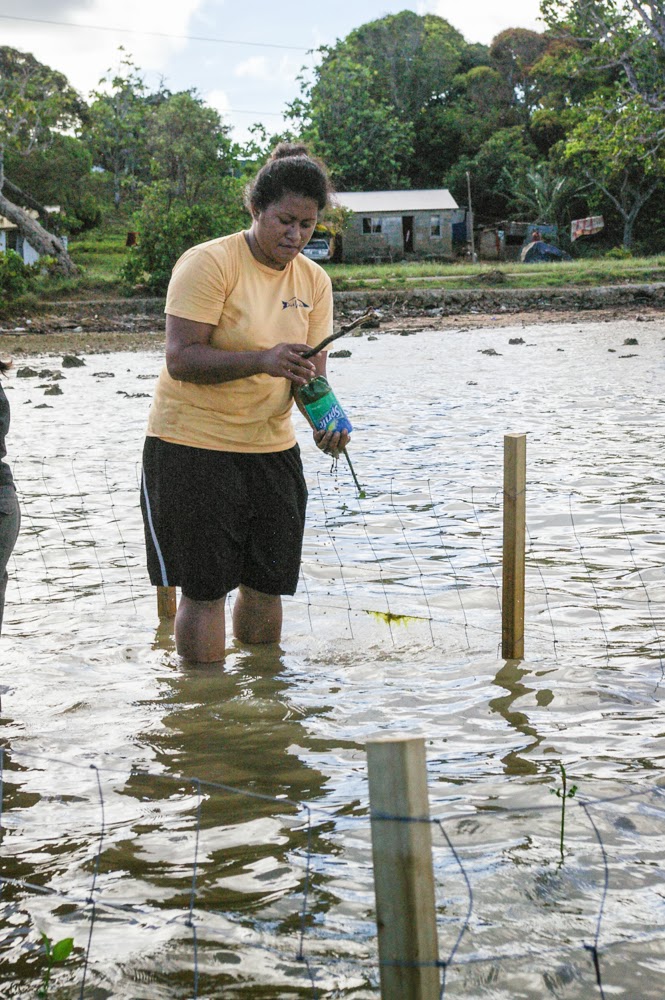
To work alongside the community with different ways to improve on the health of the coastal areas is vital for a sustainable future.  The mangroves being planted are a pilot project to showcase mangroves as a tool for climate change adaptation. The initial plot has 100 mangrove seedlings planted with a further plot coming in later December. The community helped to build the fence, essential in Vava’u to protect the seedlings from roaming pigs that search for mollusks at low tide.

Fence Building team © Karen Stone 2013

Community members from Neiafu Tahi, APTC alumni students and kids all helped plant the mangrove seedlings after they were propagated in water bottles by school kids from Liviela Government Primary School.
APTC Alumni students © Ashlee Jones 2013

An Environmental Ambassador, Lisa Tongamoa, from Neiafu Tahi, works for the project developing community support and initiatives to create ownership of their resources.
Lisa Tongamoa, Environmental Ambassador © Karen Stone 2013
It is hoped that more mangroves will be grown as an adaptation to climate change,  a workshop on sustainable harvesting of mangroves for cultural uses including dyes for mats will be happening in the New Year and further studies carried out on the impacts of climate change on the coastal area.

A huge thank you to the team and community for their efforts and support.
Some camera time © Ashlee Jones 2013
Discussing logistics © Ashlee Jones 2013
Salia back in the mangroves © Ashlee Jones 2013
Happy helpers © Karen Stone 2013
Planting mangroves Neiafu Tahi