Pages

Showing posts with label awareness. Show all posts

Tuesday, June 7, 2016

Meet our new volunteer

Malo e lelei! 

I'm VEPA's new volunteer from Canada. I am studying for a Bachelor of Philosophy and Interdisciplinary Leadership at Renaissance College, a part of the University of New Brunswick. A truly wonderful and unique program that has helped me to be able to volunteer here in Vava'u. Aside from this, I am studying environmental science and plan on focusing my future studies on marine conservation, so I am extremely excited to have this opportunity to volunteer with VEPA and their amazing island preservation initiatives!

Growing up, I have always been involved with environmental programs in my community and school. The summer prior to this I had the opportunity to intern with the Nature Trust of New Brunswick, a non-profit land trust organization that focuses on education, stewardship, and conservation of significant land in New Brunswick. A truly amazing organization that inspired me to focus my studies on conservation, specifically marine conservation from working on the coastal preserves, which fit perfectly with the work that VEPA is currently undertaking. 

Left to right: Lisa, Meredith, Courtney and Seini


So far, my time in Tonga has brought me nothing but pleasure. I've experienced a feast, church, VEPA events, and have met so many incredible people. The kindness and hospitality that has been shown towards me so far has Tonga living up to its reputation of being the "Friendly Islands"! I'm looking forward to getting to know more about Tonga's people, culture, and ways of life in the next 11 weeks that I have with VEPA. 

Malo,


Courtney

Monday, April 18, 2016

Protect Pacific Whales..


A very exciting time for our beloved whales as the focus for 2016 and 2017 SPREP programme, more information on the websites below:


The Pacific Island region is home to over half the world's species of cetaceans, whales and dolphins, including some of the least known, and as such members of the Secretariat of the Pacific Environment Programme (SPREP) agreed to focus their activities in 2016 and 2017 on a targeted regional campaign on whales. 

The ‘Protect Pacific Whales – Ocean Voyagers’ Campaign provides an opportunity for SPREP and all its Members and partners to celebrate these magnificent creatures, raise awareness on whales and their conservation, but also on ocean conservation. What happens in the ocean will inevitably impact whales.  The campaign will also address the problems facing them as ocean-dwellers that will surely ultimately impact us all.

The programme of work that is envisaged for the Protect Pacific Whales Campaign is an ambitious mixture of scientific research, training and capacity-building, exchange of information, and cultural and artistic celebration.

Join us to celebrate  whales and their place in Pacific cultures, promote their protection in the face of emerging threats, support measures to enhance their conservation, and to maximise the economic return available to Pacific island communities from the development and application of best-practice guidelines for whale-watching.  
For more information, visit our website (English and French versions available) https://www.sprep.org/yearofthewhale  and contact us at pacificwhales@sprep.org.

Wednesday, October 21, 2015

Introducing Meredith...


Meredith on the right with Lisa.


My name is Meredith Tufunga.
I’m 19 years old.
My parent is Suvenia and ‘Amusia Tufunga.
My favourite subject is Biology and Computer. 
My favourite colour is green.
I come from Olo’ua Island and I stay at Kameli.
I have ten members in my family. There are three boys and seven girls.
I was study at Mailefihi Siu’ilikutapu College for 5 years at end up at Vava’u High School for 3 years.
I’m very glad to take this time so I can share how happy I are when I became VEPA members. When I get the job I’m very happy because it can help me by increase my knowledge not only that but I know that I can fulfil my dream. Most of the time I always dream that one day I can do something so I can help to make our environment clean and not only the clean and green but also to stop the pollution that occur in our environment. So now I join VEPA so i can work together with the VEPA to protect our environment because I know that today problem in our environment can produce a huge concern for us in the future. 

So I think it’s time for us TONGA to stand up and work together for a BETTER ENVIRONMENT in the future. So the REEF OF TODAY IS THE ISLAND FOR TOMORROW. 

Meredith joins in the awareness program with Lisa, Moala and Ofa.

Wednesday, March 25, 2015

Feeling hot hot hot

and yes not just us humans, but again our corals are under thermal stress  with hot ocean water temperatures over a prolonged period of time. Other environmental issues that can cause coral bleaching is run off and pollution, extreme low tides which can cause an excessive amount of sunlight on the corals.

Just last week on a survey we noticed corals paling and bleaching in shallow waters on the reef flats and following on from the bleaching event recorded in February through April 2014, we are again watching closely.

Firstly lets just talk about the basics of coral reef formations and corals themselves:

Corals are made up from rock (limestone) which forms the skeleton and attachment for the coral, plant (zooxanthellae) that gives corals there colour as well as photosynthesizing and producing oxygen. The zooxanthellae and the polyp have a mutualistic relationship each providing benefits to the other.

The  animal is a polyp that has tiny tentacles that extend out and catch passing particles which feed the coral. There can be thousands of small polyps on a single coral head and millions spread over a coral reef area.


Anatomy of a coral polyp © Encyclopaedia Britannica.
Coral reefs provide many functions or services to people including food, enjoyment and recreation and protection from climatic events such as storms, tsunamis and waves. If a coral reef is not healthy and in balance these services can be affected. Keeping coral reefs healthy through managing fishing, reducing anchoring and pollution are some of the ways to keep our ecosystems in balance.


So what is bleaching?
This coral bleaching infographic by NOAA provides great simple information on the causes and impacts of bleaching.
When oceans temperatures exceed the normal threshold for corals (between 23C and 29C) and maintain that heat for a period of time, corals will start to drop the zooxanthellae, the corals begin to look very bright in colour, this is known as paling. If the temperatures remain high, the coral then may further bleach turning itself bright white. At this stage corals still may recover if water temperatures reduce quickly and the algae returns.

If the corals remain bleached and the water temperatures remain high, coral mortality may become an issue. Once a coral has completely bleached it is at risk of no longer providing food or habitat for marine animals as well as protection for shorelines from storms and large waves.


Those bright hot red spots are all around the waters of Tonga at the moment.

Chart showing possible bleaching stress between February and May 2015.

How can you help?

VEPA is a supporter of the CoralWatch program which can be used by divers and snorkelers to easily monitor changes in reef colour. Its free to do and we will input the data, so please if you would like to join in pop by the VEPA office located at the bottom of the Guttenbeil Plaza.


Thursday, January 29, 2015

VEPA Environmental Awareness Program - Jan 2015


So welcome back from Hainite, Lisa and Moala:
The Community Awareness Team -
Lisa, Hainite, and Moala


The Community Awareness Team now all in green!

We’ve had a great break and are back in our ta‘ovala’s

Ready to take-on twenty fifteen!


Presenting to all the GPS teacher's at Vava'u High

To kick off the new year with excitement

We went to the government high school

And told the teachers about the environment,

Which they said they thought was pretty cool.


Our team are now getting gee-d up

To teach everyone about our mangroves,

We’ve written a kids book, the schools are tee-d up,

And the replanting has begun, way to go!


Red Mangrove seedling

 
Something else we have to look forward to:

A Whale Competition for you to tell your tales

About what they mean to Tonga, to me, and to you,

And the prize? Winners will spend a day with the whales!


New office opening - Karen and Kate
Next step is to spruce up the new office

With interesting posters and pictures to peek at

If you haven’t found us we’re near the Dancing Roosters,

Come on by when you can and meet us!

Wednesday, November 27, 2013

IWCM Mangrove Rehabilitation Project for Climate Change Adaptation Update


Planting mangroves for climate change adaptation.

Living in the islands of Vava’u, Kingdom of Tonga, we are surrounded by ocean, coral reefs and fragile coastline that are susceptible to the threats of global climate change. In Vava’u alone, there are higher tides, stronger storms, winter weather in summer and summer weather in winter. The islands are seeing changes both visibly and economically associated with climate change.

Working for the IWCM Coastal Management Project, VEPA is responsible for a mangrove rehabilitation project for climate change adaptation. Sponsored by AusAid and SOPAC, this project looks into mitigating and adapting to climate change through community development. The first site we are working at is Neiafu Tahi, located on the main island of Vava’u Lahi, and a critical community area. The “Old Harbour” as it is known locally, is a small harbor for local fishing vessels, a fishing ground for the women collecting mollusks for food and a home for over 300 people directly.


The area is seeing the impacts of climate change with higher seas washing over the sea wall, storm surges and soil erosion. Our part of the project is to show how mangroves can be used as a reducing species of climate change. Mangroves all over the tropics are vital for many uses in community development.  Here in Vava’u, they provide shoreline protection from winds and waves, reduce sediments and pollutants flowing from the land to the sea and on to the coral reefs. In some areas, the mangroves are very healthy, in other areas they have been depleted due to coastal developments.

Fence to protect seedlings from pigs © Karen Stone 2013

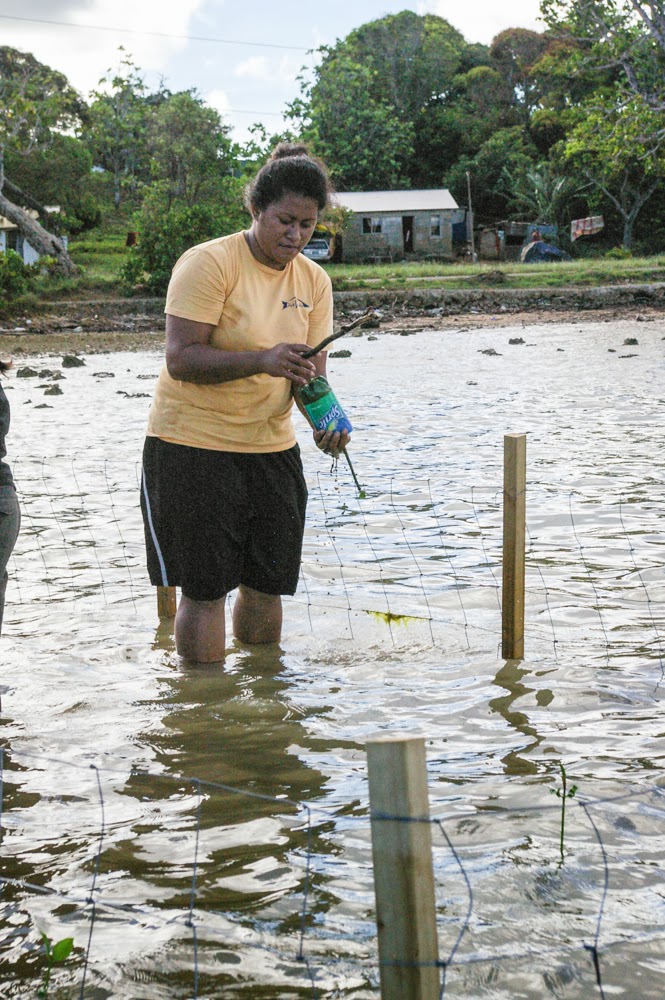
To work alongside the community with different ways to improve on the health of the coastal areas is vital for a sustainable future.  The mangroves being planted are a pilot project to showcase mangroves as a tool for climate change adaptation. The initial plot has 100 mangrove seedlings planted with a further plot coming in later December. The community helped to build the fence, essential in Vava’u to protect the seedlings from roaming pigs that search for mollusks at low tide.

Fence Building team © Karen Stone 2013

Community members from Neiafu Tahi, APTC alumni students and kids all helped plant the mangrove seedlings after they were propagated in water bottles by school kids from Liviela Government Primary School.
APTC Alumni students © Ashlee Jones 2013

An Environmental Ambassador, Lisa Tongamoa, from Neiafu Tahi, works for the project developing community support and initiatives to create ownership of their resources.
Lisa Tongamoa, Environmental Ambassador © Karen Stone 2013
It is hoped that more mangroves will be grown as an adaptation to climate change,  a workshop on sustainable harvesting of mangroves for cultural uses including dyes for mats will be happening in the New Year and further studies carried out on the impacts of climate change on the coastal area.

A huge thank you to the team and community for their efforts and support.
Some camera time © Ashlee Jones 2013
Discussing logistics © Ashlee Jones 2013
Salia back in the mangroves © Ashlee Jones 2013
Happy helpers © Karen Stone 2013
Planting mangroves Neiafu Tahi