Pages

Showing posts with label VEPA. Show all posts

Friday, January 13, 2017

Outer Island Surveys - Turtles, Birds and Trash!

December through March, outer island surveys are conducted by VEPA staff for the Vava’u Turtle Monitoring Programme, and today was the first day that the weather and swells have been kind enough for us to initiate our annual monitoring. Well the weather was polite but definately not kind as it decided to pour with rain all morning, making visibility quite difficult for navigation. However, thanks to our Captain, Riki Tiki Tours, safety is always considered first. By the time we had finished our surveys the skies were clearing!


The turtles for Tonga, nest between the months of December through March, often the females have migrated from Samoa or Fiji to return to the nesting beaches here to lay their eggs, these nesting beaches are the same for the female turtle as where they were born, so the health of these islands is of major importance to the survival of turtles. This includes the management of invasive species such as rats as well as reducing the amount of rubbish and waste that is left or drifts upon these fragile habitats.


A turtle nest (pit)

Six turtle nests were identified and tagged during the surveys today, sadly many of the tracks had been washed away with the extreme high tides and swells we have had recently.


There has been a lot of sand shift on our outer islands which results in large areas of exposed sandstone, making it harder for the turtles to access the sand areas for nesting as shown in the picture above!

Not only are the outer islands important for sea turtle nesting, but also for sea bird nesting and today we were treated to a variety of chicks. A new one for us today was the very young chicks of the Black Naped Tern (Sterna sp.), a ground laying bird that builds small rock nests upon the beach or lay their eggs in the shrubs just above the high tide mark. As they are ground nesters, these chicks and eggs are extremely susceptible to predators and damage from picnic parties that do not know they are there.

A Black Naped Tern chick being protected by the coral rubble and rock nest.


The eggs of a Black Naped Tern laying along the shoreline above the high tide mark.


 Other chicks spotted were the resident noddy, however only a few chicks were spotted in comparison to other years. Whenever, you conduct outer island surveys on bird nesting islands, you have to be not only careful where you put your feet, but also not to disturb the chicks that are on the low shrubland along the coast.


A noddy chick sits just off the ground in the low shrubs on the outer islands.


Sadly though, the islands were also blighted with plastic waste, diapers, glass bottles and some PVC tubes that we believe may have been used as a float.


Two of these PVC tubes were collected on seperate beaches


Thanks to the hard work of our team today - Lisa, Seini and Kelli, the islands were left much cleaner than when we got there.


The photos above show the team of Lisa, Seini and Kelli cleaning up the two outer islands surveyed today, its always so sad to see the waste discarded on the beaches and impacting upon the marine and terrestrial life that inhabits these islands and the surrounding area.


Wednesday, October 21, 2015

Introducing Meredith...


Meredith on the right with Lisa.


My name is Meredith Tufunga.
I’m 19 years old.
My parent is Suvenia and ‘Amusia Tufunga.
My favourite subject is Biology and Computer. 
My favourite colour is green.
I come from Olo’ua Island and I stay at Kameli.
I have ten members in my family. There are three boys and seven girls.
I was study at Mailefihi Siu’ilikutapu College for 5 years at end up at Vava’u High School for 3 years.
I’m very glad to take this time so I can share how happy I are when I became VEPA members. When I get the job I’m very happy because it can help me by increase my knowledge not only that but I know that I can fulfil my dream. Most of the time I always dream that one day I can do something so I can help to make our environment clean and not only the clean and green but also to stop the pollution that occur in our environment. So now I join VEPA so i can work together with the VEPA to protect our environment because I know that today problem in our environment can produce a huge concern for us in the future. 

So I think it’s time for us TONGA to stand up and work together for a BETTER ENVIRONMENT in the future. So the REEF OF TODAY IS THE ISLAND FOR TOMORROW. 

Meredith joins in the awareness program with Lisa, Moala and Ofa.

Thursday, January 29, 2015

VEPA Environmental Awareness Program - Jan 2015


So welcome back from Hainite, Lisa and Moala:
The Community Awareness Team -
Lisa, Hainite, and Moala


The Community Awareness Team now all in green!

We’ve had a great break and are back in our ta‘ovala’s

Ready to take-on twenty fifteen!


Presenting to all the GPS teacher's at Vava'u High

To kick off the new year with excitement

We went to the government high school

And told the teachers about the environment,

Which they said they thought was pretty cool.


Our team are now getting gee-d up

To teach everyone about our mangroves,

We’ve written a kids book, the schools are tee-d up,

And the replanting has begun, way to go!


Red Mangrove seedling

 
Something else we have to look forward to:

A Whale Competition for you to tell your tales

About what they mean to Tonga, to me, and to you,

And the prize? Winners will spend a day with the whales!


New office opening - Karen and Kate
Next step is to spruce up the new office

With interesting posters and pictures to peek at

If you haven’t found us we’re near the Dancing Roosters,

Come on by when you can and meet us!

Saturday, November 1, 2014

Beach time!

The office has been full on recently with community and business consultations following on from the BioRap carried out in February, however luckily for the team, this week also included a pilot beach restoration project in Talihau community.

The project brought together by SPREP, Joanna Ellison, Senior Lecturer at University of Tasmania, Ministry of Environment and Communication and VEPA aims to reduce coastal erosion through ecosystem based adaptation.

So what is ecosystem based adaptation (EbA)?

EbA uses biodiversity and ecosystem services as an adaptation tool. Ecosystem services are the benefits of the ecosystem to humans i.e food, water, resource, security etc.

Damage by pigs on fragile coastal vegetation.
Looking for sites around Vava'u, it was discovered that many of the beaches were suffering from coastal erosion, caused by both human impacts such as sand mining, burning of vegetation and littering as well as pigs destroying the fragile vegetation as well as wave and storm damage.

The site chosen for the pilot project was Talihau, a coastal community who has moderate to severe erosion along the beach. The road had collapsed in part after Cyclone Ian in 2014, however this area needs considerable work done before an EbA. However, the eastern end of the beach was suitable for a rehabilitation plot.


Beach clean up by the girls.
The fence being built.
A fence is erected around the site to prevent further damage to the vegetation from pigs and human use and in heavily scoured areas palm fronds and vegetation are stacked on the edge to catch sand brought into the beach from high tides, waves and storms.
Palm fronds placed below greenery and then staked down to prevent waves washing them away.

Access path between the fenced area to reduce impacts on vegetation and scoured areas.

Palm fronds are placed along scoured lip of coast to help catch sand.
The community of Talihau has named the project "Ma'ae Kaha'u 'o Talihau" and will monitor the progress of the protected site, the palm fronds will be changed out when needed and eventually beach vines will be planted to increase the coastal security. The Ministry of Environment and Communication and VEPA will continue to assist the community. Signs are being made to show the value of healthy beaches.


School presentation at GPS Talihau by Winnie from MEC and Paul from SPREP.


This is an important step in protecting coastlines and it is hoped that more beaches and communities will have EbA restoration programs in the future.

Thursday, June 12, 2014

World Ocean's Day 9th June 2014

Yesterday here in Vava'u we celebrated World Ocean's Day. The event was co-ordinated by VEPA  and Endangered Encounters and sponsored by many of the local businesses in town as well as a large number of volunteers collecting rubbish underwater and along the shoreline.

Marine pollution and marine debris are 2 of the many  issues that are oceans are facing, rubbish thrown both directly into the water as well as rubbish blowing in from the shoreline here our creating issues to our marine environment.

Our poster was made by kids at the Vava'u Public Library Fun Day.

Volunteer diver bringing up tyres.
Hanite working hard.
Lisa and Kat sorting rubbish.

ANZ Bank volunteers.

No clean up should be carried out without a specialist BBQ chef.
Rubbish placed in trees is removed by Brian and Tracy

 We would like to thank all of the volunteers that gave their time to help with the event, both in cleaning up and also making it fun.

Sponsors of the event provided sausages, gloves, rubbish bags, water, tents and all the essentials to make these event successful. Below is a list of sponsors:

Endangered Encounters, Riki Tiki Tours, VEPA, Beluga Diving, ANZ Bank, Seventh Heaven, Pafilio Tangitau Store, Mounu Island Resort, Teisa and Kalolo, Coconut Car Rentals, Trouble in Paradies, Vava'u Shipwrights, Seahorse Power, GIO Recycling, WestPac Bank.

Wednesday, April 9, 2014

Malo e lelei Vava'u!


G’day! As the new Australian volunteer at VEPA I thought I should write a quick introduction about myself and what I hope to be doing here in 2014.

My name is Eileen “Kat” Tuite and I will be working within the VEPA office for 12 months in the volunteer position of Environmental Education Program Trainer. My role here is to work with the local staff and volunteers to assist in creating suitable environmental education programs that they can deliver to the community and schools within Vava’u. During my time here I hope to contribute to VEPA’s venture in increasing awareness of conservation and environmental issues, as well as encouraging engagement with environmentally sustainable initiatives in ways that serve to effectively manage environmental issues at a community level. 

I have a background in teaching Biology, Chemistry and Environmental Science in secondary schools in Australia. Prior to that I completed a Bachelor of Science with Honours at the Australian National University, with majors in Zoology, and Evolutionary and Behavioural Ecology. I have worked with Australia’s CSIRO on ecological research projects, and have volunteered with wildlife rescue groups in both Australia and Vietnam.

I am a keen environmentalist, and whilst teaching Science in secondary schools I worked to integrate concepts of sustainability and environmental issues into the curriculum and students’ lives. I have always been particularly passionate about wildlife conservation, but I am also known to be an avid composter, an enthusiastic recycler, and a bit of a green-thumb in the garden.

In all my travels so far I have rarely seen a place as spectacularly beautiful as Vava’u, it is truly a place that needs to be conserved and maintained for future generations. I am excited to have this opportunity to live in Vava’u, and I am looking forward to working alongside the students and communities in contributing to vital environmental conservation efforts.
So until you here from me next time,
Toki sio!

Friday, March 7, 2014

Coral Bleaching event in the Vava'u Group.....


A rapid survey team assessing the reefs on Tonga reports observations of the first stages of mass coral bleaching.  The SPREP (South Pacific Regional Environmental Programme) BioRAP (Biodiversity Rapid Assessment Programme) working in the northern Tonga group of islands called “Vava’u” reports about 1-3% of corals are bleached.  Some corals are white; others partly white, and others are neon colors like light blue or yellow. 
Due to increasing water temperatures, the NOAA Coral Watch program previously announced a bleaching watch for Tonga (February 2014).  The team, recorded seawater temperatures rising in the last week to about 30.5o C, as well as the appearance of bleached corals.  Most of the bleaching observed was between 10 meters and the surface, however individually bleached coral colonies were observed up to depths of 30 meters in some places. A range of coral species was recorded as bleaching.
Corals bleach when increased seawater temperatures occur over a period of time; the corals, which are made up of skeletons, animals and single-cell plants, are placed under stress. When the algae (zooxanthellae or plant living within the animal), which give corals not only its color but also the ability to photosynthesize and feed, are released by the coral colony, the coral becomes bright white. As the coral has lost the plant component it loses them as a food source and is under extreme stress to survive.  Corals may recover from bleaching events if seawater temperatures decrease to within the limits of coral development. Bleaching events effect many different areas of the marine ecosystem including the reef fish as well as weakened coral reefs provide little protection for shorelines.
Area of bleaching coral within the Vava'u archipelago.

Most days have been sunny, with very light winds and small waves, but February 28th was cloudy and rainy when the team departed Vava’u.  The SPREP BioRAP team was surveying reefs and terrestrial ecosystems in the Vava’u group in support of conservation planning in Tonga.  The Kingdom of Tonga is located north and slightly east of New Zealand, and east of Fiji in the Pacific, and the Vava’u group of islands is at about 18.6500o S.
The coral reef areas identified as bleaching sites will continue to be monitored and recorded for further analysis.
The marine team was based on the Waitt Institute Scientific Platform to conduct the marine surveys of Vava’u as part of the BioRAP programme with SPREP, Ministry of Lands, Environment, Climate Change,  and Natural Resources, Waitt Foundation and VEPA.

Wednesday, February 19, 2014

BIORAP Survey of the Vava'u archipelago

This is a vital and important survey initiated by Ministry of Lands, Environment, Climate Change and Natural Resources, SPREP, Waitt Foundation and VEPA, to explore the habitats of both land and sea for species diversity, species habitat and to collaborate resources for the improved ecosystem health of coral reefs, sea birds, reptiles, marine mammals and not forgetting plants.

As part of the marine team, we have 10 researchers involved in identifying, counting and monitoring the health of one of the most important ecosystems for Pacific Island nations, coral reefs. Coral reefs provide valuable protection and ecosystem services to both cultural and commercial avenues in Tonga.

Our studies include
Coral Taxonomy - species identification
Coral Health monitoring - percentage of coral cover, disease and invasive species impacts.
Reef Fish Biodiversity - species list and abundance.
Commercial Fish - fish used both culturally and commercially and there abundance for sustainability.
Invertebrates -  crustaceans, molluscs, nudibranch and other small yet vitally important organisms that clean, provide nutrients and food to other marine life.

Our team consists of 4 Tongan partners, 2 from Ministry of Agriculture, Fisheries, Forests and Foods and 2 from Ministry of Lands, Environment, Climate Change and Natural Resources, as well as overseas scientists residing in American Samoa, Hawaii, Singapore, Australia and oh little ole me!

So what does BIORAP mean - its a rapid assessment of the biodiversity of the islands and marine life in Vava'u. There are many areas that have data deficient statistics and though this survey is short, so much valuable data will be collected and passed on to the government and communities to fill gaps and to exchange with local knowledge on the status of the ecosystems.

None of this would of happened without a lot of input from varying parties striving towards the same goal, to improve and protect the ecosystem health and species habitat of Vava'u for a sustainable future.

For the marine team, we are currently based on the Waitt Institute Scientific Research Platform, with a crew working above and beyond to enable us to carry out and conduct these surveys of the outer coral reefs. We have spanned far and wide including Fonualei, Toku, Maninita and many other far reaching islands.
Lutjanus kasmira - Blue lined snapper.

Acropora sp. - healthy coral.

Monitoring of introduced species Trochus niloticus.


We have 7 more days to go as I write this, at present we have conducted over 30 hours of studying the reefs and their dynamics underwater and other hours are left to compile the data we collect as we blow bubbles.

This is a fantastic project, one VEPA holds very dear to its heart, but without all the hard work from all the partners, scientists and funders, this would not be happening. We have a long road ahead and a lot more data to collect in the next week, but we will keep you updated as we can.

Malo
Karen


Wednesday, November 27, 2013

IWCM Mangrove Rehabilitation Project for Climate Change Adaptation Update


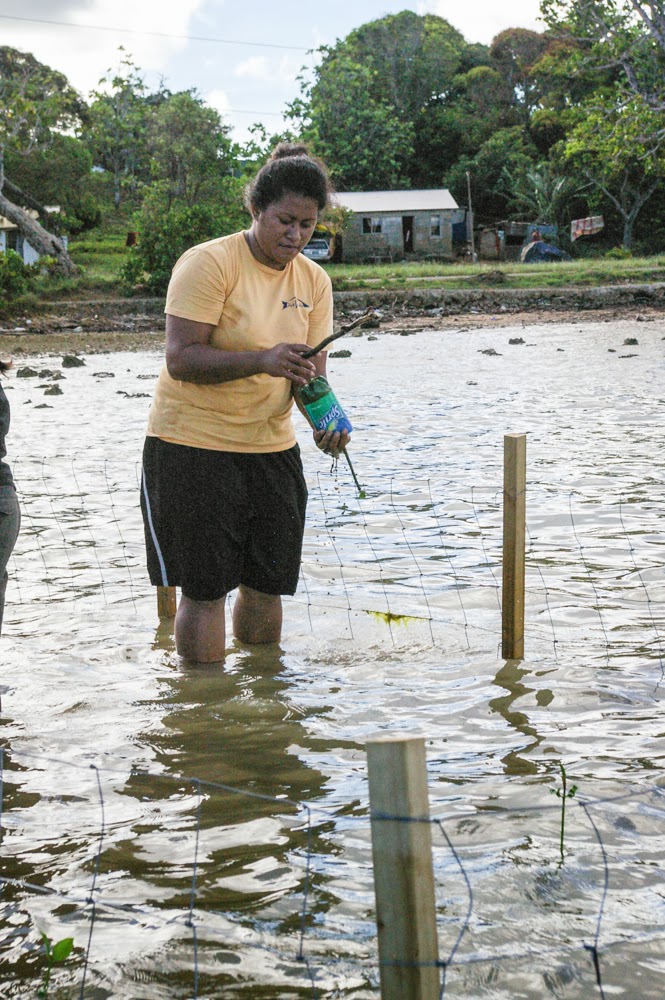
Planting mangroves for climate change adaptation.

Living in the islands of Vava’u, Kingdom of Tonga, we are surrounded by ocean, coral reefs and fragile coastline that are susceptible to the threats of global climate change. In Vava’u alone, there are higher tides, stronger storms, winter weather in summer and summer weather in winter. The islands are seeing changes both visibly and economically associated with climate change.

Working for the IWCM Coastal Management Project, VEPA is responsible for a mangrove rehabilitation project for climate change adaptation. Sponsored by AusAid and SOPAC, this project looks into mitigating and adapting to climate change through community development. The first site we are working at is Neiafu Tahi, located on the main island of Vava’u Lahi, and a critical community area. The “Old Harbour” as it is known locally, is a small harbor for local fishing vessels, a fishing ground for the women collecting mollusks for food and a home for over 300 people directly.


The area is seeing the impacts of climate change with higher seas washing over the sea wall, storm surges and soil erosion. Our part of the project is to show how mangroves can be used as a reducing species of climate change. Mangroves all over the tropics are vital for many uses in community development.  Here in Vava’u, they provide shoreline protection from winds and waves, reduce sediments and pollutants flowing from the land to the sea and on to the coral reefs. In some areas, the mangroves are very healthy, in other areas they have been depleted due to coastal developments.

Fence to protect seedlings from pigs © Karen Stone 2013

To work alongside the community with different ways to improve on the health of the coastal areas is vital for a sustainable future.  The mangroves being planted are a pilot project to showcase mangroves as a tool for climate change adaptation. The initial plot has 100 mangrove seedlings planted with a further plot coming in later December. The community helped to build the fence, essential in Vava’u to protect the seedlings from roaming pigs that search for mollusks at low tide.

Fence Building team © Karen Stone 2013

Community members from Neiafu Tahi, APTC alumni students and kids all helped plant the mangrove seedlings after they were propagated in water bottles by school kids from Liviela Government Primary School.
APTC Alumni students © Ashlee Jones 2013

An Environmental Ambassador, Lisa Tongamoa, from Neiafu Tahi, works for the project developing community support and initiatives to create ownership of their resources.
Lisa Tongamoa, Environmental Ambassador © Karen Stone 2013
It is hoped that more mangroves will be grown as an adaptation to climate change,  a workshop on sustainable harvesting of mangroves for cultural uses including dyes for mats will be happening in the New Year and further studies carried out on the impacts of climate change on the coastal area.

A huge thank you to the team and community for their efforts and support.
Some camera time © Ashlee Jones 2013
Discussing logistics © Ashlee Jones 2013
Salia back in the mangroves © Ashlee Jones 2013
Happy helpers © Karen Stone 2013
Planting mangroves Neiafu Tahi